The Bay Area can solve homelessness. When we work together.
Beyond Homeless brings together the leaders, capital, resources and expertise across sectors to build a coordinated, scalable response, designed to meet the full size of the need.
200+
Leaders and Organizations
10+
Cities and Counties
3
Active Collaboratives
Beyond Silos.
The Bay Area has the resources, expertise, and solutions. We are uniquely positioned to scale solutions rooted in alignment.
The backbone the Bay Area has been missing
Beyond Homeless serves as the connective infrastructure across a fragmented system—aligning public agencies, private sector, philanthropy, and service providers to move from isolated efforts to coordinated execution.
Regions that have embraced this kind of cross-sector, regional collaboration are seeing stronger outcomes and renewed optimism. That change is possible in the Bay Area.
Our Dual Operating Model
Convening & Co-Creation
Uniting leaders across sectors to align roles, share ownership, and build a coordinated, all-of-the-above response.
Coordination & Execution
Unlocking capital, advancing innovation, and driving initiatives through to completion—with clear accountability and results.
Our Network
Our Stakeholders: 200+ organisations working together
A growing collaboration across housing, government, philanthropy, and community services.
We brought 50 civic, philanthropic, and government leaders to Texas to study homelessness models delivering measurable impact at scale. From Haven for Hope in San Antonio to Community First! Village in Austin, this is what they saw, and what it means for the Bay Area.
Three Collaboratives · 2026
Our 2026 Priorities
Campus Hub Development
Advancing large-scale, integrated campuses that bring housing, services, and community into one coordinated system. Designed to operate at scale, these hubs create clear pathways from crisis to stability and independence—while building a model that can be replicated across the Bay Area.
Stage 2: Feasibility underway
Policy and Funding Reform
Examining the funding and policy pathways that shape delivery of interim and large-scale housing. Convening voices across sectors to analyze the barriers and approval processes that affect whether solutions can scale in real-world conditions.
15 of 50 organizations committed
Innovation Collaborative
Building the infrastructure that allows the system to function at scale—new funding models, shared data, and modern tools for development and service delivery. Driving transparency, accountability, and better outcomes across the region.
San Jose pilot active · DAF voucher in development
Beyond Homeless - Documentary One
Our award-winning documentary follows the search for what actually works in addressing homelessness. It has screened for tens of thousands of people worldwide.
Documenting the formation of the Bay Area Collaborative - the delegation to Texas, the leaders who showed up, and the work now underway to build the region's first campus hub.
Festival Recognition - Finding Hope
Stay connected to the work
Monthly updates on progress, priorities, and opportunities to align resources for success.
Our Network
Partner Organizations
Government and Policy
Office of Sen. Catherine BlakespearOffice of Sen. Catherine Blakespear
Offers
State legislative power, housing committee influence, and solutions-focused policy leadership.
Looking for
Coordinated systems linking behavioral health, interim shelter, and permanent housing as one continuum.
CA State Senate (Sen. Dave Cortese)CA State Senate (Sen. Dave Cortese)
Offers
Legislative authority, constituent reach, and an advocacy platform to advance homelessness solutions.
Looking for
Broad regional collaboration and alignment on state policy levers.
Nonprofit and Service Partners
The Salvation ArmyThe Salvation Army
Offers
Direct service delivery infrastructure, board leadership, and warm introductions to tech-sector funders.
Looking for
Connections to major tech employers willing to invest in homelessness solutions.
Seeds of Hope Silicon ValleySeeds of Hope Silicon Valley
Offers
Proven CFV replicator program, community-informed design, and a ready team of architects, engineers, and operators.
Looking for
Project entitlements, a full funding stack, and expanded partnerships with funders and city officials.
DignityMovesDignityMoves
Offers
Interim housing expertise, barrier-elimination strategies, and a scalable, cost-effective building model.
Looking for
A state policy shift toward interim housing solutions and support for functional zero campaigns.
Urban Vision AllianceUrban Vision Alliance
Offers
A private-sector recruitment formula, campus model expertise, and innovative DAF financing vehicles.
Looking for
Municipalities ready to partner on site identification and capital or service funding.
Restorative PathwaysRestorative Pathways
Offers
Trauma-informed service expertise, behavioral health integration, and financial modeling for recovery-oriented systems.
Looking for
Aligned funding streams, cross-system data coordination, and scalable recovery-oriented financial models.
Miracle MessagesMiracle Messages
Offers
A proven phone-buddy and family reconnection model, a USC research partnership, and housed-community engagement strategies.
Looking for
Integration of relational support as a recognized service metric and funding for peer-based connection programs.
Felton Institute / Circe SoftwareFelton Institute / Circe Software
Offers
60+ social and clinical programs, transitional housing, crisis response infrastructure, and proprietary IT solutions.
Looking for
Corporate and agency partners for sustainable housing alternatives and tech-enabled service delivery.
Haven SafeHaven Safe
Offers
Business administration and HR advice, Santa Clara County power mapping and change strategy, first-hand casework experience, caseworker trainings, executive coaching, user-centered design, systems engineering, and board service.
Looking for
Funding, an Executive Director, marketing/PR, and warm introductions to artists and to tech-company decision-makers for charitable team-building events.
Wings of Eagle FundWings of Eagle Fund
Offers
Collaboration with community nonprofits and developers to clean up the environment and develop properties that are both beneficial and sustainable.
Looking for
Token investors backed by tangible assets, providing equity for purchasing and cleaning up environmentally impacted sites.
Backbone and Leadership
Beyond Homeless
Independent InstituteIndependent Institute
Placeholder
Example Partner
Offers
Implementation capacity, Stakeholder relationships, Pilot programs
Looking for
Strategic clarity, Coordination support, Funding
Placeholder
Regional Coalition
Offers
Multi-county coordination, Policy alignment, Member network
Looking for
State-level alignment, Funding for backbone capacity
Site capacity, Development know-how, Regulatory analysis
Looking for
Site identification, Streamlined approvals, Operating partners
Legal, Design and Professional
Placeholder
Design Consultancy
Offers
Brand and storytelling, UX research, Communications strategy
Looking for
Mission-aligned clients, Cross-sector projects
Danu StrategyDanu Strategy
Are you a Bay Area organization working on homelessness solutions?
Join the collaborative
Get monthly updates and ways to plug in—bringing new partners, resources, and ideas into the work.
Get Involved
Not working in homelessness? You can still play a critical role.
If you care about solutions—and have resources, networks, or influence to contribute—there are simple ways to help move this forward.
✉
Stay Connected
One monthly update on what's happening and what's working. No Noise.
▶
Fund What Works
Help unlock feasibility, site development, and scalable solutions across the region.
↗
Bring Others In
Connect us to the partners, leaders, and platforms that can accelerate progress.
3 Active Initiatives
Bay Area Network
About the Network
From alignment to action. Working as one system.
This is a working group that learns and acts together toward our shared 2026 goals. Beyond Homeless brings together leaders, meeting in focused groups, advancing initiatives, and reporting progress back to the broader collaborative.
The network spans government, philanthropy, real estate, nonprofits, healthcare, education, and legal, each bringing different perspectives, priorities, and capabilities. Not everything aligns for everyone, and that is the point. This is an all-of-the-above approach, where every effort plays a role in moving the system forward, unlocking resources that would otherwise stay siloed and driving outcomes no single organization could reach alone.
How it works
Find the partners who move your work forward.
The network is designed to build the right relationships, aligned to real initiatives and shared goals. The Beyond Homeless team facilitates introductions with care, ensuring trust and alignment on both sides.
1
Browse the directory, see who offers what, and what they are looking for.
2
Request an intro, the team connects you when there is real alignment.
3
Move an initiative, turn the connection into shared, funded action.
3 Active Initiatives
Bay Area Network
The Network
Active Initiatives
Each project below is a live initiative in the network. See what is needed right now and get in touch if you can help.
Campus Hub Development Collaborative
From the Beyond Homeless documentary Finding Hope
Campus Hub Development Collaborative
Ready to get involved?
What is a Campus Hub?
Transformational housing and support, delivered at scale
A campus or hub is a place-based model designed to bring housing, services, and opportunity together in one coordinated environment. On a shared site—ranging from smaller properties to large repurposed campuses—individuals can access the full range of support needed to move off the streets and into stability, including shelter, healthcare, behavioral health, recovery services, and workforce pathways.
Each campus is shaped by its local context, but the core idea is consistent: operating at meaningful scale allows communities to reduce unsheltered homelessness more quickly, create clearer pathways for individuals, and align fragmented systems into one coordinated approach. A single site may include multiple housing types—from emergency shelter to permanent supportive housing—alongside services tailored to the population being served.
These hubs are not one-size-fits-all solutions, nor are they positioned against other approaches. They are developed collaboratively, adapting proven models to local needs. The goal is straightforward: bring people indoors, stabilize their lives, and connect them to long-term pathways forward.
This model is not tied to any single policy ideology and is not positioned against other approaches. It is being developed collaboratively - not imposed. The goal is simply to get people off the streets and into stable, supported lives.
COLLABORATIVE GOALS
200
Sites identified across Bay Area
20
Feasibility studies (target 2026)
5
In active acquisition (target)
1–3
Sites acquired by Dec 2026
2026 Goal
The Collaborative Campus
What we are building and why
The Bay Area has more than enough resources, organizations, and expertise to address homelessness at scale. What it has lacked is a shared physical infrastructure - a campus where services, housing pathways, and community support exist in one coordinated place.
Inspired by Haven for Hope in San Antonio - which achieved a 77% reduction in downtown homelessness - we are working with Bay Area partners to develop the region's first collaborative campus hub. The goal is not to replicate Haven exactly, but to apply its proven operating principles to the Bay Area context: scale, wraparound services, housing pathways, and genuine accountability for outcomes.
What a campus hub provides
Housing, healthcare, behavioral health, recovery services, workforce training, and legal support—integrated in one place. These campuses are designed to foster community, build individual agency, and create clear pathways toward stability and independent living.
What makes ours different
Each site is operated by an independent 501(c)(3), working through defined scopes of work with a range of local service providers, operators, and partners. This creates transparency, shared accountability, and a coordinated system—built collaboratively, not controlled by any single entity.
The scale we are working toward
Designed to serve 1,000+ individuals, these campuses leverage large, well-utilized sites to operate at meaningful scale. With significant capital investment and coordinated partners, the model is built to deliver measurable impact and expand across the region over time.
See individual project details, floor plans, and planning documents:
How it gets funded
Braided public and private capital
Large-scale campuses require funding structures that most public systems cannot provide alone. This collaborative is building a blended model that combines philanthropic acquisition capital with public operational funding — enabling speed, flexibility, and durability.
$20M
Philanthropic acquisition target for 2026
20+
Funders to be pitched with funding strategy
$10–40M
Estimated site acquisition range per campus
Land Opportunities
There is an abundance of public and private land in California uniquely positioned for the purpose of interim and PSH housing and service facilities. City, county and state owned land that is currently zoned for this purpose totals over 100K acres. Additionally, faith based organizations across the state have over 40,000 acres. Perhaps most relevant, there are over 75,000 acres of undeveloped land owned by the public higher education and many small universities are closing, creating opportunity to repurpose small to mid-sized campuses for housing and service facilities.
Get Involved
There is a role for you here.
Government agencies, developers, nonprofits, philanthropists, and people with lived experience all have a role in building the Bay Area's first campus hub.
Understanding how policy and regulation affect facility development and program delivery
We analyze how permitting and zoning rules, funding restrictions, and the legal definitions of shelter, housing, and services affect whether projects can actually be delivered, and we share that analysis with stakeholders and decision-makers.
This collaborative convenes homelessness stakeholders across sectors to study what slows project delivery and to give decision-makers clear, well-researched analysis of how agency processes and approvals affect outcomes on the ground.
Our work is grounded in one question: what actually helps housing and services get delivered on the ground? We examine where permitting, funding flexibility, and project timelines help or hinder real outcomes.
The research behind this analysis, spending data, outcome comparisons, national benchmarks, is on the Data page.
2026 Goals
01
Analyze how state and local funding rules affect interim, rapid, and campus-based housing models, and inform stakeholders on where an estimated $250M+ could move toward delivery-ready projects within 12-24 months.
02
Analyze how zoning and permitting requirements affect the timeline to open large-scale sites, and brief decision-makers on approaches, including by-right zoning and streamlined permitting, that other jurisdictions have used to reach approximately 6-month timelines.
03
Coalition alignment and shared understanding across 50+ cross-sector stakeholders (government, philanthropy, nonprofit, business, and people with lived experience), building a common, research-grounded picture of the 3-5 policy questions that most affect housing and service delivery in 2026.
04
Establish broad stakeholder alignment around a clear, actionable path to functional zero unsheltered homelessness, with defined models, delivery targets, and a shared framework for measuring progress across the Bay Area.
Working across the collaborative
Policy change is only meaningful when it unlocks real delivery. This collaborative works hand in hand with the other two workstreams.
Campus Hub Collaborative
Policy and regulatory analysis informs site acquisition and campus development
View →
Innovation Collaborative
Shared data and reporting infrastructure supports transparency and measurement of outcomes
View →
Get Involved
There is a role for you here.
Whether you represent an organisation or want to stay informed as an individual, joining connects you to the coalition's work as it happens.
Innovation Collaborative
From the Beyond Homeless documentary Finding Hope
Innovation Collaborative
System Platform · Innovative Financing · Technology & AI
Ready to get involved?
About This Collaborative
Modernizing the system to unlock outcomes
The Innovation Collaborative modernizes how the homelessness ecosystem operates — removing blockers, unlocking sidelined resources, and enabling faster, more coordinated action across organizations, capital, and civic leaders.
At its core, this is about empowering people. By automating research, administrative work, and streamlining fragmented processes, it frees up time for human-to-human engagement, better decisions, and stronger outcomes.
This collaborative does not deliver services or develop facilities. Its mandate is coordination, visibility, and unlocking new resources. If that is your kind of work — in technology, data, finance, or systems — this is where you belong.
2026 Goals
01
Deploy a jurisdiction-wide homelessness system platform in one pilot city or county
02
Achieve majority participation from projects and key stakeholders in that jurisdiction
03
Create high-level capacity and pipeline visibility across housing and service types
04
Build a repeatable methodology that can be adopted by additional jurisdictions
05
Launch DAF-backed voucher pilot with Community Foundation and Housing Authority
06
Pilot at least one AI or technology implementation that demonstrably increases system capacity
Innovative Financing
Federal funding is shifting and the homelessness sector operates on a scarcity culture around public dollars. Meanwhile, significant private capital sits unused — looking for clearer pathways to impact.
This workstream is designing and piloting a privately-funded voucher pathway — a legally viable DAF-backed voucher structure using a Community Foundation as the vehicle, partnering with a Housing Authority to distribute and administer them. It targets populations and housing types not well served by existing public vouchers.
2026 deliverable
A pilot cohort of privately funded vouchers placed into housing, and a replicable framework other regions can adopt.
Technology & AI
The Bay Area's technology sector is uniquely positioned to help. The system is constrained not just by funding, but by workforce shortages, administrative overload, and fragmented tools. AI and technology can change that — if applied to real problems, not speculative pilots.
This workstream convenes homelessness stakeholders and technology leaders to identify high-priority pain points and pilot implementations that demonstrably increase capacity.
Guardrails
All technology work is required to be ethical, trauma-informed, and privacy-conscious. Innovation is aligned to real system needs — not what is technically interesting.
Get Involved
There is a role for you here.
Technologists, philanthropists, data specialists, city housing staff, and community foundations — this collaborative needs people who can build, finance, and connect.
Homelessness by the Numbers
Source: HUD · SF Controller · Haven for Hope
Data & Research
The evidence behind the work
This is the central evidence hub for Beyond Homeless. Key statistics, the interactive national dashboard, and links to the full research archive are all here. Every policy position and project decision taken by the collaborative is grounded in this body of evidence.
Data is maintained by the Independent Institute. For the full body of research, policy reports, and analysis behind this work, visit independent.org →
California spends more per homeless person than almost any state - and homelessness has continued to rise. San Francisco alone has increased spending by nearly 260% since 2013 with no corresponding decline in street homelessness. The data is not ambiguous: spending without a comprehensive model does not work. Haven for Hope in San Antonio demonstrates what does.
Large-scale campus and hub models outperform fragmented, site-by-site approaches. Coordinated infrastructure delivers faster placements, better service integration, lower per-person costs, and stronger long-term stability.
02
Interim housing works when designed as an empowerment system, not a holding pattern. The distinction is not duration; it is design, integration, and intent.
03
Policy enables scale, but delivery infrastructure determines impact. The greatest bottleneck is not the absence of policy; it is the lack of clear, repeatable pathways for large-scale facilities to get built.
04
Private capital and executive leadership are essential, not optional. The strongest models combine public commitment with philanthropic risk capital and private-sector leadership, enabling the speed and innovation that public systems alone cannot provide.
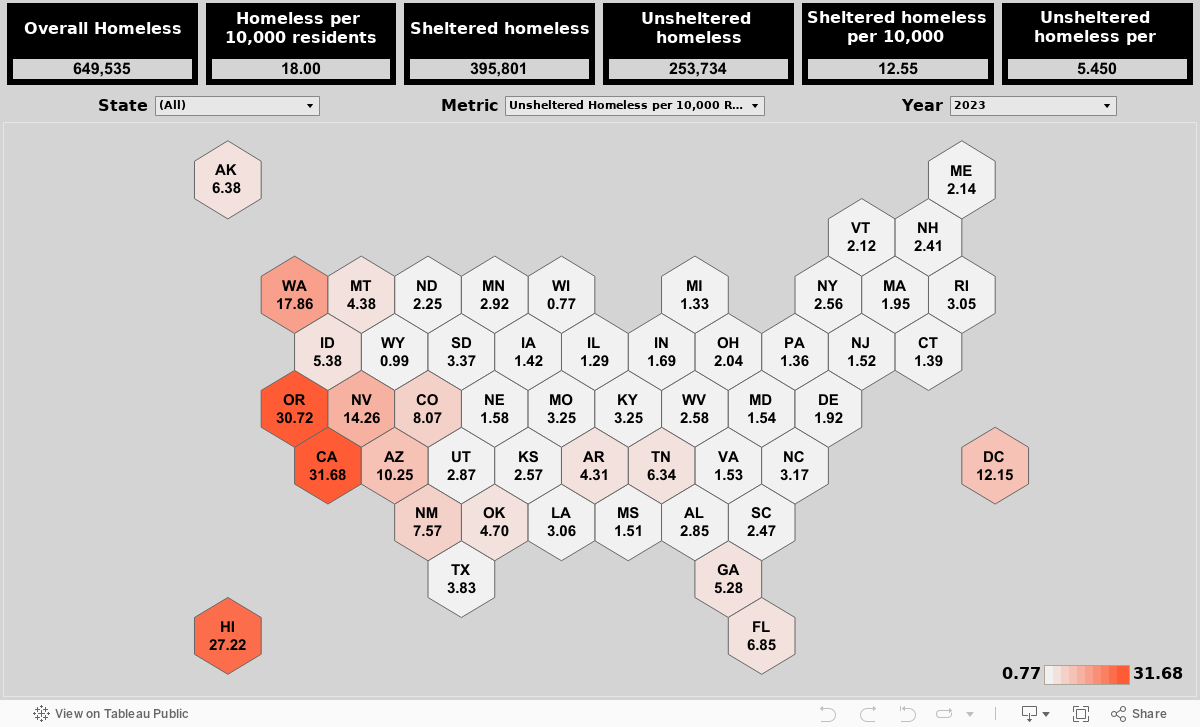
Interactive Dashboard - US Homelessness by State
State-level data. County-level detail and trend graphs coming in 2025 update.
Performance metrics determine whether resources are helping or hurting. Without tracking outcomes, spending becomes self-justifying. BH tracks this data so the collaborative can make decisions grounded in evidence, not assumption.
What comes next
The current dashboard shows state-level data. The next version will include Continuum of Care (CoC) level data for more granular Bay Area tracking, and will add trend line graphs so changes over time are visible. 2025 figures will be added when released.
Research & Resources
The body of work behind this initiative
Beyond Homeless is grounded in years of policy research, field work, and original scholarship. That research lives at the Independent Institute. White papers, policy reports, op-eds, and the book are all accessible there.
Beyond Homeless asked: if some jurisdictions have reduced street homelessness, why hasn't the Bay Area? The answer was not funding or intent, but a lack of coordinated infrastructure. Today, our growing coalition is applying proven models, and moving from fragmented efforts to coordinated delivery.
Origin
From documentary to action: a timeline
2023
Beyond Homeless began as a research and documentary initiative led by the Independent Institute in Oakland. The award-winning film Finding Hope, alongside a supporting white paper, explored what was actually working in cities making progress, and what was blocking results in places like the Bay Area. The film was viewed by tens of thousands, screened at theaters and venues across the region, and recognized at film festivals, sparking widespread interest and engagement.
2024
That momentum evolved into a growing community coalition focused on implementing those insights locally. In partnership with the Bay Area Council, we hosted convenings and co-creation sessions at their headquarters, engaging more than 200 organizations across government, philanthropy, real estate, service providers, and community leaders. We also hosted virtual exchanges with leaders across the country, learning directly from regions where new models were delivering results.
2025
A critical inflection point came with a Texas delegation, bringing together Bay Area leaders including mayor's offices, state senators, developers, funders, and service organizations to visit and learn from large-scale models like Haven for Hope. This cross-state learning effort marked a shift from theory to action, grounded in real-world outcomes.
2026
Following that trip, we convened a "learnings into action" summit, aligning stakeholders around shared priorities for 2026 and formally launching the collaboratives that are now advancing this work.
The result is a clear shift in the Bay Area conversation: moving away from one-size-fits-all approaches toward an all-of-the-above model, where collaboration across sectors is the path to delivering real, scalable solutions.
The Texas Delegation
When 60 leaders saw the proof for themselves
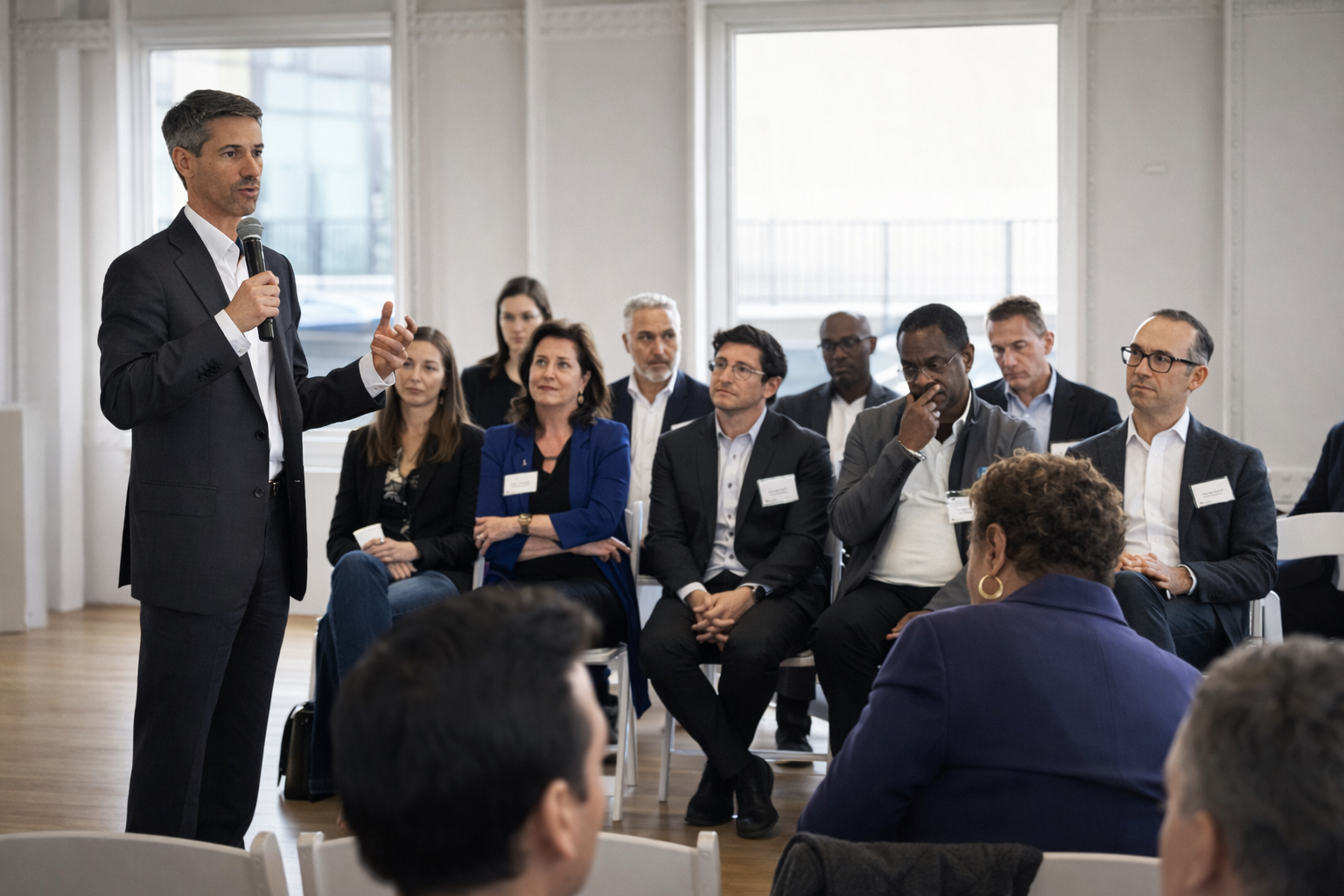
In October 2025, Beyond Homeless convened a two-day delegation of 60 Bay Area leaders across government, philanthropy, real estate, business, and service providers to align on how to collaborate more effectively back home. This was a working session, not a tour, focused on building shared understanding and momentum for coordinated action.
The trip also brought California and Texas leaders together, not as rivals but as peers, exchanging practical insights on how cities are tackling homelessness on the ground.
Participants visited large-scale facilities including Haven for Hope and Community First! Village, seeing firsthand how interim and permanent housing models perform at scale, with clear evidence on both human outcomes and financial impact.
Just as important, leaders saw how campus-based models drive regional collaboration, aligning stakeholders, funding, and services into a coordinated system required to deliver at scale.
Haven for Hope
San Antonio, TX - October 2025
Community First! Village
Austin, TX - October 2025
Delegation represented
Mayors' offices & city housing departments
Philanthropic funders & foundations
Nonprofit service operators
Real estate developers
Private sector & business leaders
Policy & systems experts
Google, Chan Zuckerberg Initiative
SF Foundation, Bay Area Council
Urban Vision Alliance, Dignity Moves, BACS
What the delegation concluded
Not all models are replicable - but the operating principles are
Haven is specific to San Antonio. Many cities have taken components. The return on investment speaks for itself.
Scale requires purpose-built infrastructure, not programmatic layering
Campuses and hubs must be treated as regional assets, not city-by-city experiments.
A private champion matters enormously
Haven's founding required a billionaire with the ear of government. Bill Greehey gave $80M to Haven and its partners. That kind of conviction creates permission for everyone else.
This complements housing first - it doesn't compete with it
Haven is the Bay Area's single largest assessor for connection to housing programs. The framing is adding capacity, not trying something new.
November 20, 2025 — San Francisco
From insight to alignment
Following the Texas delegation, Beyond Homeless convened regional leaders in San Francisco to translate what was learned into shared direction. The room included mayors from Oakland, San José, and Berkeley, alongside county officials, philanthropy, operators, developers, and policy partners.
Aligned around
Large-scale campuses and hubs as the regional priority
Signal from cities
Strong interest in regional partnership models that don't add administrative burden
The outcome
The meeting marked the transition from learning to commitment, and the Bay Area Collaborative was formally structured within months
Preview: This is how partner profiles will appear on the BH platform once you submit your details. The three highlighted cards below are live. The remaining nine are sample partners shown to illustrate the format.
Beyond Homeless
Backbone Organization
Coordination backbone for Bay Area homelessness response, convening cities, funders, nonprofits, and policy partners.
We Offer
Cross-collaborative coordination
Convening capacity and meeting facilitation
Single source of truth on collaborative progress
We're Looking For
Partners willing to share status updates openly
Funders interested in regional coordination
Service providers with capacity to scale
II
Independent Institute
Parent Organization
Public policy research organization and parent of the Beyond Homeless initiative, providing institutional backbone and governance.
We Offer
Institutional infrastructure and governance
Policy research and analysis capacity
Senior leadership convening power
We're Looking For
Research partners on housing and homelessness policy
Funders aligned with rigorous outcomes measurement
Policy practitioners
DS
Danu Strategy
Strategic Consulting
Strategy and operations consultancy supporting the Beyond Homeless platform build and collaborative coordination workflows.
We Offer
Strategic planning and stakeholder coordination
Platform and workflow design
Cross-functional program management
We're Looking For
Collaborative members ready to engage on shared goals
Feedback on platform features and workflows
Sample Partner
BC
Bayview Community Services
Service Provider
Direct services provider operating shelter, case management, and housing navigation across San Francisco's southeast neighborhoods.
We Offer
240 shelter beds with wraparound services
Bilingual case management capacity
Established relationships with city HSH
We're Looking For
Funding for permanent supportive housing pipeline
Behavioral health partners
Real estate partners with site control
Sample Partner
FH
Foundation for Housing Equity
Philanthropy
Bay Area family foundation funding scalable, evidence-based responses to homelessness with a focus on systems change.
We Offer
$4M annual grantmaking capacity
Convening of peer funders
Long-horizon program funding (5+ year commitments)
Ex-political staff, lawyers, fundraisers, developers, real estate people - we need specific expertise, not just goodwill. Tell us what you've actually done.
Tell your representatives that homelessness is a priority for you, and that you want to see solutions that work. Show up on a Saturday. Share the film with the one person who needs to see it.
We're not looking for general enthusiasm. We're looking for people who've done things. A former legislative staffer who knows how to move a bill. A lawyer who can review a land use agreement. A fundraiser who knows how to close a major gift.
Tell us who you are and what you've done. Michael Seiler, our Chief Impact Officer, reviews every submission personally.
About you
When there is a bill hearing, we send you a template and the right address. When there is physical work to do, we tell you where and when. When the second film drops, you hear first.
Sign up for action alerts
Support the work
Your money does specific things
We are the coordination infrastructure - the organisation that puts the right people in rooms together and keeps projects moving. Your contribution funds that directly.
$50
Materials for a community briefing with 20 leaders
$250
A month of policy coalition coordination
$1,000
A feasibility session with city officials on Golden Gateway
$5,000+
Strategic donor conversation - naming, campus sponsorship, capital campaign
If you have a fund at Fidelity, Schwab, or Vanguard Charitable - this work is exactly the kind of thing it was designed to support. We can receive DAF grants.